The Conversation (0)

ImageFlow / Adobe Stock
Welcome to the Investing News Network's weekly brief on tech news and tech stocks driving the market.
We also break down next week's catalysts to watch to help you prepare for the week ahead.
In this article:
This week's tech sector performance
Markets faced elevated geopolitical risk on Monday (April 6) after US President Donald Trump threatened to devastate Iran’s economy and infrastructure if the Strait of Hormuz was not reopened.
The president made the threats in posts on social media over the Easter weekend and set a deadline of 8:00 p.m. EST on Tuesday (April 7), after which the US would “rain down hell."
Amid reports of continued negotiations between the US, Israel, Iran and a group of regional mediators, US stocks closed modestly higher after volatile intraday trading.
Trump’s ultimatum and threat of large‑scale strikes if Iran failed to comply remained the central narrative on Tuesday as talks continued. Trading was mixed, with modest overall gains in the S&P 500 (INDEXSP:.INX) and Nasdaq Composite (INDEXNASDAQ:.IXIC), but weakness in the Dow Jones Industrial Average (INDEXDJX:.DJI).
Wall Street futures jumped almost immediately after a two week ceasefire agreement was announced at the 11th hour. Trading remained elevated after Wednesday’s (April 8) cash open as Iranian officials informed Reuters that the Strait of Hormuz could reopen in the coming days, lifting investor sentiment.
Wall Street closed sharply higher on Wednesday despite statements from Iranian parliament speaker Mohammad Baqer Qalibaf, who accused the US of violating three points of Iran's 10 point proposal.
Also on Wednesday, the US Federal Reserve released minutes from its March gathering, revealing that policymakers are increasingly considering interest rate increases. This shift in thinking comes as central bank officials adjust their 2026 inflation projections upward in response to war-induced oil price shocks.
Futures were in the red on Thursday (April 9), with investors questioning the durability of the ceasefire amid reports that shipping traffic through the Strait of Hormuz remained stifled.
Fresh US economic data showing higher‑than‑expected jobless claims, softer income and still‑firm core personal consumption expenditures price index data added to the cautious tone. Markets also faced a software drag after Anthropic’s launch of Claude Managed Agents, and as Meta Platforms' (NASDAQ:META) new artificial intelligence (AI) model reignited worries that agentic AI could disrupt traditional SaaS models.
Updates on negotiations between Israel and Lebanon during the session helped ease worries, ultimately allowing all three major US stock indexes to regain ground.
Stocks wavered on Wall Street on Friday (April 10) ahead of planned talks between the US and Iran in Islamabad, Pakistan, on Saturday (April 11). US stocks closed mixed on Friday, with the Nasdaq gaining on the session, while the Dow and the S&P 500 ended lower. The S&P/TSX Composite Index (INDEXTSI:OSPTX) ended higher.
3 tech stocks moving markets this week
1. Intel (NASDAQ:INTC)
Intel was the top performer, with a weekly gain of 35.43 percent.
2. Monolithic Power Systems (NASDAQ:MPWR)
Monolithic Power Systems, a fabless power management semiconductor company, saw a weekly performance improvement of 26.3 percent.
3. Lam Research (NASDAQ:LRCX)
Lam Research, a semiconductor equipment manufacturer, saw a weekly gain of 26.25 percent.
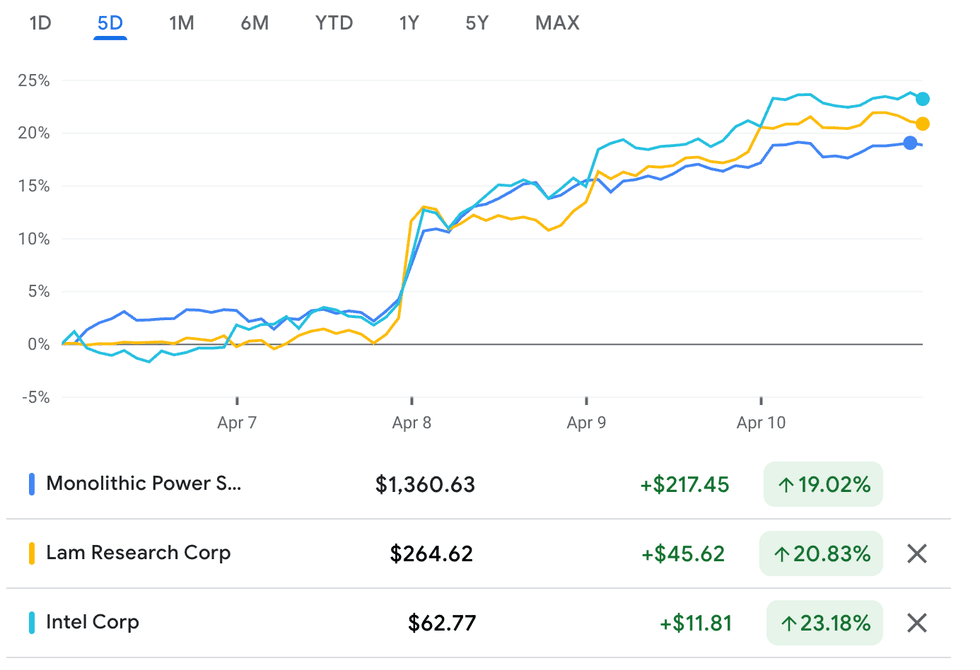
Monolithic Power Systems, Lam Research and Intel performance, April 6 to 10, 2026.
Chart via Google Finance.
Top tech news of the week
- Shares of Meta rose nearly 7 percent on Wednesday, with gains extending further after hours. The rise came after the introduction of Muse Spark, the first public release of the company’s newest AI model, and the debut product from Meta’s Superintelligence Labs, which is designed to supercharge its advertising business. Meta says Muse Spark will boost ad revenue by delivering more personalized recommendations and shopping experiences. Spark, already powering Meta AI, reportedly achieves high-level reasoning with less computing power than previous models. It is “purpose built” for Meta’s suite of social media services, and the company has plans to integrate it into Facebook, Instagram, Messenger, WhatsApp and Meta’s AI glasses in the near future.
- OpenAI CFO Sarah Friar told CNBC that the company plans to reserve a portion of shares for individual investors when it goes public. She did not comment on the timeline for a debut.
- BlackBerry (TSX:BB,NYSE:BB) released slightly better-than-expected Q4 earnings, reporting US$156 million in revenue, up about 10 percent year-on-year. Adjusted earnings per share came in at US$0.06, beating the US$0.05 consensus. Operating cashflow was up about 9 percent to US$45.6 million.
- Alphabet (NASDAQ:GOOGL) and Intel (NASDAQ:INTC) plan to deepen their collaboration to advance AI infrastructure, with Google Cloud pledging to use multiple generations of Intel Xeon CPUs, including Xeon 6, to power AI training, inference and general cloud workloads. The companies will also expand co‑development of custom infrastructure processing units, specialized chips that offload networking, storage and security tasks from the main CPUs to improve efficiency at large AI data centers.
- The US House Committee on Foreign Affairs is reportedly planning an April 22 vote on at least 10 bills related to chip exports.
- CoreWeave (NASDAQ:CRWV) has struck a US$21 billion deal to supply Meta with computing power through 2032. CoreWeave will provide AI cloud capacity to Meta from multiple data centers powered in part by NVIDIA's (NASDAQ:NVDA) Rubin system of chips. CoreWeave also announced a "multi-year" agreement with AI developer Anthropic on Friday. Anthropic will use CoreWeave’s cloud computing data centers for its Claude AI model workloads.
- Amazon (NASDAQ:AMZN) CEO Andy Jassy’s annual shareholder letter, published on Wednesday, says the company’s chip business now has an annual revenue run rate of more than US$20 billion and could generate around US$50 billion a year if those chips were sold externally like a standalone vendor’s products. He added that this business is growing at triple‑digit rates year-on-year, and that AWS’ AI revenue run rate is already above US$15 billion in the first quarter of 2026.
Tech ETF performance
Tech exchange-traded funds (ETFs) track baskets of major tech stocks, meaning their performance helps investors gauge the overall performance of the niches they cover.
This week, the iShares Semiconductor ETF (NASDAQ:SOXX) increased by 13.15 percent, while the Invesco PHLX Semiconductor ETF (NASDAQ:SOXQ) gained 12.58 percent.
The VanEck Semiconductor ETF (NASDAQ:SMH) increased by 10.9 percent.
Tech news to watch next week
Next week, financial sector earnings will offer insights into credit health, loan growth and investment banking performance. Taiwan Semiconductor Manufacturing Company's (NYSE:TSM) quarterly report will also serve as a vital indicator for global semiconductor and AI capital expenditures for 2026.
Macro data will provide a clearer view of wholesale inflation, impacting Fed policy considerations.
Don't forget to follow us @INN_Technology for real-time news updates!
Securities Disclosure: I, Meagen Seatter, hold no direct investment interest in any company mentioned in this article.
https://twitter.com/INN_Technology
https://www.linkedin.com/in/meagen-seatter-23675b193/
mseatter@investingnews.com